Swollen Feet and Ankles in Pregnancy: What's Normal and What Needs Attention

Close-up of a swollen ankle elevated on pillows.
Puffy feet and ankles are one of the most visible signs of late pregnancy. By the third trimester, many women look down at their feet and barely recognise them. Shoes that fit comfortably at 20 weeks no longer close at 32 weeks. The ankles have become indistinct from the lower leg.
This is, for the majority of pregnant women, a completely normal physiological response to pregnancy. But it is also a symptom that can occasionally signal something more serious — preeclampsia, a blood clot, or kidney problems — and knowing the difference matters.
Dr. Shachi Singh, consultant obstetrician at Prakash Hospital, Sector 33, Noida, explains why pregnancy swelling happens, what normal looks like, what helps, and the specific warning signs that require urgent medical attention.
Why Swelling Happens in Pregnancy
Pregnancy causes the total blood volume to increase by approximately 40 to 50%. The body also retains significantly more fluid overall. Progesterone relaxes blood vessel walls, making them more permeable — fluid leaks from the blood vessels into surrounding tissues more easily than outside of pregnancy. Gravity naturally pulls this fluid into the lower extremities — the ankles, feet, and calves.
The growing uterus adds to the problem. As the uterus enlarges, it compresses the inferior vena cava (the large vein running along the right side of the spine that returns blood from the legs to the heart) and the pelvic veins. This compression reduces venous return from the legs, causing blood to pool and fluid to leak into tissues of the lower legs and feet.
The result is pitting oedema — swelling where pressing a finger into the skin leaves a temporary pit or indentation.
This is normal. It is physiology. It is not dangerous by itself.
What Normal Pregnancy Swelling Looks Like
Timing: Gradually develops through the second trimester, is most pronounced in the third trimester, and often worse in the final 4 to 6 weeks.
Pattern: Bilateral — both feet and ankles, roughly symmetrically. Mild swelling extending to the lower calves.
Variation through the day: Classically worse at the end of the day after standing or walking, and better in the morning after a night lying down (gravity is no longer pulling fluid downward).
Triggers: Hot weather makes it worse (blood vessels dilate more in heat). Prolonged standing or sitting. Long days of physical activity.
Absence of other symptoms: Normal pregnancy swelling is not accompanied by headache, visual changes, upper abdominal pain, or significant facial or hand swelling.
Resolves after delivery: Normal oedema clears within a week or two of delivery as the body excretes the accumulated fluid.
What Helps
1. Elevation
The most effective and simplest measure. Elevating the feet above the level of the heart reduces hydrostatic pressure in the lower limb veins and encourages fluid to drain back toward the trunk. Lie down with feet propped on a pillow for 20 to 30 minutes, several times a day. Even keeping the feet on a footstool while sitting helps.
2. Movement
While prolonged standing or sitting worsens pooling, regular gentle movement significantly improves venous return. Walking activates the calf muscle pump — the calf muscles act as a secondary "heart" for the venous circulation of the legs, squeezing blood upward with each step. A 20 to 30 minute walk daily is more effective for leg swelling than rest alone.
Ankle exercises while sitting: point and flex the feet 10 to 20 times every hour if you have a desk job or are travelling.
3. Reduce Sodium
Excess sodium drives fluid retention. Reducing salty foods — pickles, papads, packaged snacks, restaurant food, added salt — reduces the sodium-driven fluid accumulation that adds to the physiological oedema of pregnancy.
4. Increase Potassium
Potassium counteracts sodium's fluid-retaining effect. Bananas, coconut water, curd, dal, and spinach are Indian foods rich in potassium that directly counterbalance sodium's contribution to swelling.
5. Stay Hydrated
Counterintuitively, drinking more water reduces swelling. When the body is dehydrated, it retains fluid more aggressively. Adequate hydration — 8 to 10 glasses daily — keeps fluid circulating and reduces retention.
6. Comfortable Footwear
Shoes that cut into the foot or restrict circulation worsen swelling and discomfort. Flat, wide-fitting shoes or sandals that accommodate swollen feet are necessary in late pregnancy. Avoid tight elastic socks or stockings that restrict the ankle (though graduated compression stockings, which are tighter at the ankle and looser higher up, actually help).
7. Compression Stockings
Graduated compression stockings — knee-length or thigh-length, with stronger compression at the foot and ankle that gradually reduces higher up — support venous return and reduce leg oedema. They are particularly useful for women who must stand or sit for prolonged periods. They should be put on in the morning before getting up, when swelling is at its lowest.
8. Cool Water
Soaking the feet in cool water (not ice-cold) for 15 to 20 minutes provides temporary relief and reduces the discomfort of hot, tight, swollen feet — particularly relevant in India's climate.
9. Sleep on the Left Side
Sleeping on the left side reduces compression of the inferior vena cava (which runs on the right side of the spine) and improves venous return from the lower body.
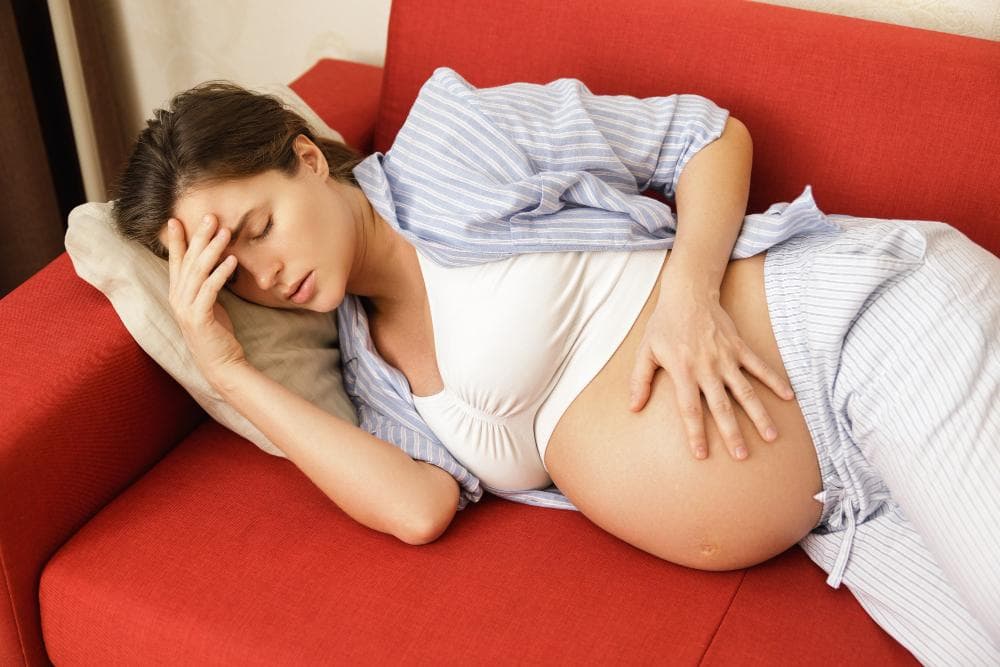
A pregnant woman is lying down on the couch, looking tired and distressed as she holds her forehead with her left hand and her belly with her right.
When Swelling Is Not Normal: Warning Signs
This is the most important section. Certain patterns of swelling during pregnancy require prompt medical assessment:
Sudden rapid swelling — particularly of the face and hands. Gradual ankle oedema developing over weeks is normal. Swelling that appears suddenly and involves the face (puffiness around the eyes, lips) and hands is a warning sign of preeclampsia.
Swelling accompanied by headache, visual changes, or upper abdominal pain. This combination — oedema plus severe headache, flashing lights or blurred vision, or pain under the right ribs — indicates possible preeclampsia. This is an obstetric emergency. Do not wait. Call your doctor or go to the maternity emergency department the same day.
Swelling in one leg only, particularly with pain or redness. Symmetrical bilateral swelling is typical of normal pregnancy oedema. New swelling that is confined to one leg — particularly with calf pain, tenderness, warmth, or redness — may indicate a deep vein thrombosis (blood clot). Pregnant women have higher clotting risk. DVT requires urgent diagnosis and treatment. Go to the hospital.
Swelling with difficulty breathing or chest pain. Possible pulmonary embolism — a blood clot that has travelled to the lungs. This is a life-threatening emergency.
Swelling with decreased urine output or very dark urine. May indicate kidney involvement.
Significant swelling in the first or early second trimester. Early-onset significant swelling needs investigation — it is not typical of normal pregnancy physiology at that stage.
Postpartum Swelling
Many women notice that swelling actually worsens in the first 2 to 3 days after delivery before it starts to improve. The body mobilises the large amount of retained fluid from labour, IV fluids given during delivery, and hormonal shifts — all of which pass through the tissues before being excreted in urine. Significant urination in the first week postpartum is normal and reflects this diuresis.
Most postpartum swelling resolves within 1 to 2 weeks. Swelling that persists, involves one leg asymmetrically, or is accompanied by any systemic symptoms postpartum also needs evaluation — DVT and postpartum preeclampsia can both present after delivery.
Antenatal Care in Noida and Greater Noida
Dr. Shachi Singh at Prakash Hospital, Sector 33, Noida, provides comprehensive antenatal monitoring — including blood pressure assessment, urinalysis, and evaluation of all pregnancy symptoms — for women across Noida and Greater Noida.
To book a consultation with Dr. Shachi Singh, call: +91 97023 46853
Clinic Hours: Monday to Saturday, 9 AM – 6 PM | Sunday, 10 AM – 2 PM
Clinic Address: D-12A, 12B, Sector-33, G.B. Nagar, Noida, Uttar Pradesh 201301
Frequently Asked Questions
1. Is ankle swelling in pregnancy dangerous?
Gradual bilateral ankle swelling that worsens through the day and improves after lying down is normal in late pregnancy and not dangerous. Sudden facial or hand swelling, one-sided leg swelling with pain, or swelling with headache, visual changes, or upper abdominal pain requires immediate medical attention.
2. When does pregnancy swelling start and end?
Most women notice ankle swelling beginning in the second trimester and becoming more pronounced in the third trimester. It typically resolves within 1 to 2 weeks of delivery as the body excretes the accumulated fluid through increased urination.
3. Can I exercise with swollen feet in pregnancy?
Yes — gentle exercise like walking is actually one of the most effective ways to reduce pregnancy leg swelling by activating the calf muscle pump. Avoid prolonged standing or sitting in one position. If exercise significantly worsens the swelling or causes pain, seek assessment.
4. Should I restrict water intake to reduce swelling?
No. Restricting water intake worsens fluid retention because a dehydrated body holds on to fluid more aggressively. Staying well-hydrated — 8 to 10 glasses of water daily — actually reduces swelling alongside reducing sodium intake.
This blog is written for educational and informational purposes only. Please consult Dr. Shachi Singh or a qualified obstetrician for guidance specific to your pregnancy and symptoms.