Diastasis Recti: Understanding Abdominal Separation After Pregnancy

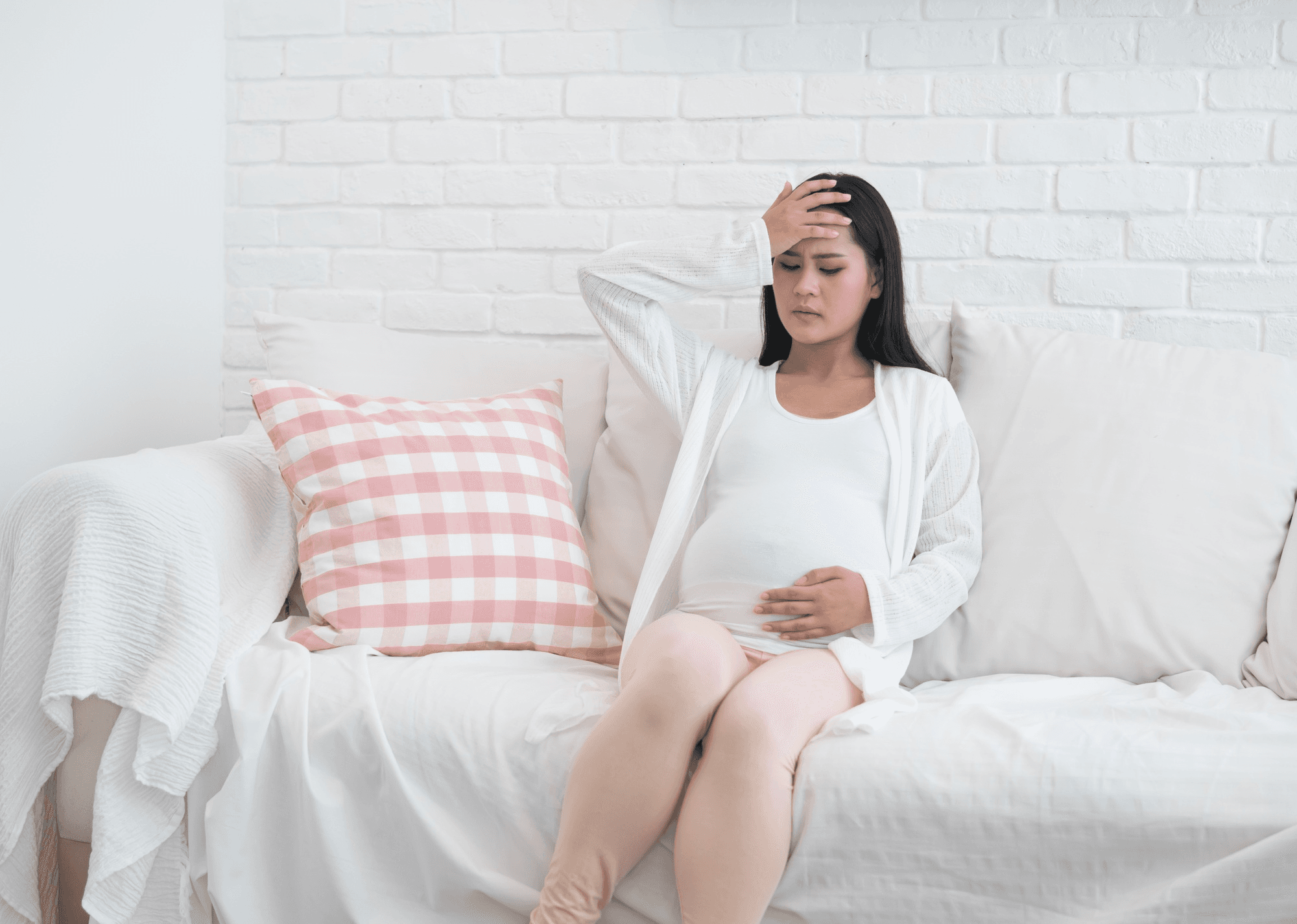
Pregnant woman sitting by a chair, holding her stomach and covering her mouth, experiencing nausea or abdominal discomfort.
Many women are puzzled by a persistent "pouch" or ridge down the centre of their abdomen months or years after delivery — something that does not go away despite exercise and weight loss. This is often diastasis recti — a separation of the two columns of the rectus abdominis muscle that has not fully closed after pregnancy.
Dr. Shachi Singh, consultant gynaecologist and obstetrician at Prakash Hospital, Sector 33, Noida, explains.
What Diastasis Recti Is
The two parallel bands of the rectus abdominis muscle (the "six-pack" muscles) are joined at the midline by the linea alba — a fibrous structure running from the sternum to the pubic bone. During pregnancy, the growing uterus stretches the abdominal wall, and the linea alba widens to accommodate the expansion. In most women after delivery, this gap gradually closes. In some, it remains wider than normal — a gap of 2 cm or more at the level of the navel is typically defined as diastasis recti.
The result is a functional weakness of the midline — the two muscle columns cannot work together efficiently. This manifests as a visible "dome" or ridge down the centre of the abdomen when the core is activated (getting up from lying, coughing, curling up), a protruding belly despite returning to pre-pregnancy weight, lower back pain from inadequate core support, and sometimes urinary incontinence from the same pelvic floor dysfunction.
Risk Factors for Persistent Diastasis
- Multiple pregnancy (twins, triplets) — extreme abdominal stretching
- Large baby
- Multiple previous pregnancies — less opportunity for full recovery between pregnancies
- Genetics — some women are naturally more prone to linea alba laxity
- Previous large weight gain
- Returning to high-impact exercise or abdominal exercises too early post-delivery (particularly crunches and sit-ups, which increase intra-abdominal pressure and may worsen rather than close the gap)
How to Self-Check for Diastasis Recti
Lie on your back with knees bent. Place your fingertips horizontally across the midline of your abdomen, at the navel. Slowly lift just your head and shoulders (like the start of a sit-up) and feel for a gap between the muscle bands that your fingers sink into. If two or more fingers fit into the gap, a clinically meaningful diastasis is likely present.
This self-check is approximate — a physiotherapist assessment (physical examination plus ultrasound) provides accurate measurement of gap width and linea alba quality.
Treatment
Physiotherapy — the cornerstone: A women's health physiotherapist experienced in diastasis recti assesses the gap, the linea alba quality, and the functional core strength, and designs a progressive exercise programme. The focus is on:
- Deep abdominal muscle activation (transversus abdominis — the deep muscle that compresses the abdomen and loads the linea alba correctly)
- Pelvic floor co-activation
- Avoiding exercises that increase diastasis (traditional crunches, sit-ups, heavy lifting with breath-holding)
- Progressive loading to stimulate linea alba remodelling
Most women with diastasis recti improve significantly with an appropriate physiotherapy programme. The gap may not close completely, but functional strength and the visible "doming" improves substantially.
Abdominal support garments: A firm abdominal support during recovery can improve comfort and proprioception (awareness of core position). Not a substitute for rehabilitation.
Surgical repair (abdominoplasty with plication): For severe, functionally limiting diastasis that has not improved with physiotherapy, surgical repair by a plastic or reconstructive surgeon can close the gap. This is elective surgery, typically not performed until at least 12 months post-delivery and after a completed course of physiotherapy.
Gynaecological Care in Noida and Greater Noida
Dr. Shachi Singh at Prakash Hospital, Sector 33, Noida, assesses diastasis recti and coordinates physiotherapy referral for women across Noida and Greater Noida.
To book a consultation with Dr. Shachi Singh, call: +91 97023 46853
This blog is for informational purposes only.