Is A Paraovarian Cyst Dangerous? Symptoms, Risks & Treatment

Felt model of a uterus and ovaries being studied through a magnifying glass to explain the detection of an ovarian cyst and education regarding reproductive health.
You went in for a routine ultrasound, maybe as part of an antenatal check-up, or to investigate some pelvic discomfort, and the report came back mentioning a paraovarian cyst. Now you are sitting with a term you have never heard before, trying to figure out if this is something serious. It is an understandably unsettling experience. So here is what you actually need to know.
A paraovarian cyst is, in the vast majority of cases, benign and non-threatening. Most women who have one do not even know it. But "usually harmless" is not the same as "always harmless," and understanding when a paraovarian cyst needs attention and when it does not is exactly what this guide is for.
Dr. Shachi Singh, senior gynecologist and laparoscopic surgeon at Prakash Hospital, Sector 33, Noida, regularly helps women across Noida and Greater Noida understand and manage gynecological findings like these, which sound alarming on paper but are far more manageable than they seem.
What Is A Paraovarian Cyst?
A paraovarian cyst, also called a paratubal cyst, is a fluid-filled sac that forms near the ovary or fallopian tube, but not on or inside the ovary itself. That distinction matters. It sits in a region called the broad ligament, the tissue that supports the uterus, ovaries, and fallopian tubes. The name breaks down simply: para means "beside" or "near," and ovarian refers to the ovary. So it is, quite literally, a cyst beside the ovary.
1. Where Do Paraovarian Cysts Come From?
Unlike ovarian cysts, which often form in response to hormonal fluctuations during the menstrual cycle, paraovarian cysts have a different origin entirely. They are thought to arise from remnants of embryonic structures that were present during fetal development and simply never fully disappeared. Specifically, remnants of the Müllerian duct (which forms female reproductive organs) or the Wolffian duct (which forms male reproductive organs in males, but leaves behind traces in females) can persist and slowly form cysts over time.
This means their development has nothing to do with your hormones, your diet, or anything you have done. They are, essentially, a developmental leftover.
2. How Common Are They?
Paraovarian cysts account for roughly 5 to 20% of all adnexal masses found near the ovary and fallopian tube. They are most commonly found in women in their third and fourth decades of life, though they can appear at any age. Many are discovered entirely by accident during an ultrasound performed for an unrelated reason.
Are Paraovarian Cysts Dangerous?
The direct answer is: usually not, but it depends on the size, what is inside the cyst, and whether complications develop.
1. Most Are Benign And Asymptomatic
The majority of paraovarian cysts are simple, fluid-filled, and completely benign. They sit quietly near the ovary, cause no symptoms, and often resolve on their own without any treatment. A woman might go her whole life without knowing she had one.
2. Can They Become Cancerous?
This is the question most women ask first. The risk of malignancy in paraovarian cysts is very low, estimated at around 2 to 3% in most clinical studies. Research from the Journal of Obstetrics and Gynaecology of India, which studied 51 patients with paraovarian cysts, found no malignant cases in their cohort. For cysts that appear simple and fluid-filled on ultrasound, the risk of cancer is less than 1%.
That said, a cyst with solid components, irregular walls, or internal projections on ultrasound needs further evaluation. This is when blood tests for tumour markers and possibly an MRI or diagnostic laparoscopy become relevant.
3. When Does A Paraovarian Cyst Become A Problem?
There are specific situations where a paraovarian cyst warrants medical attention and possibly treatment:
1. When It Grows Large
Most paraovarian cysts are between 1 and 8 centimetres in size and remain stable. In rare cases, they can grow to 20 centimetres or more. When they enlarge significantly, they begin pressing on surrounding structures, such as the bladder, bowel, kidneys, or uterus, causing discomfort, frequent urination, constipation, or a persistent feeling of heaviness in the lower abdomen.
2. When It Twists (Torsion)
This is the complication that requires urgent attention. When a paraovarian cyst grows large enough, it can twist around the tissue that holds it in place. This cuts off the blood supply to the cyst and, critically, to the adjacent ovary and fallopian tube. Torsion causes sudden, severe abdominal pain often accompanied by nausea and vomiting, and is a gynecological emergency.
Research from the Indian Journal of Obstetrics and Gynaecology found that approximately 18% of paraovarian cysts in a clinical study presented with adnexal torsion. If torsion is not treated quickly, typically through emergency laparoscopic surgery, it can result in ovarian ischemia (loss of blood supply) and, in severe cases, loss of the ovary.
3. When It Ruptures Or Bleeds
A cyst can rupture either on its own or due to trauma, causing internal bleeding and acute pelvic pain. This is less common than torsion but similarly needs prompt medical evaluation.
4. When It Has Suspicious Features On Imaging
If an ultrasound reveals that the cyst has solid areas, thick walls, or internal projections rather than being a simple, clear fluid-filled sac, it needs to be assessed more carefully. In these cases, your doctor will likely recommend tumour marker blood tests and possibly an MRI before deciding on management.
Paraovarian Cyst Vs. Ovarian Cyst - What Is the Difference?
Many women confuse these two because they can look similar on an ultrasound and cause similar symptoms. The key differences are:
| Paraovarian Cyst | Ovarian Cyst | |
|---|---|---|
| Location | Near the ovary, in the broad ligament | On or inside the ovary itself |
| Origin | Embryonic remnants (Müllerian/Wolffian duct) | Hormonal activity or pathological process |
| Hormonal response | Does not respond to hormones | Many types shrink with hormonal changes |
| Cancer risk | Very low (2–3%) | Varies by type |
| Disappears on its own | Sometimes, especially if small | Often, especially functional cysts |
| Diagnosis | Ultrasound — seen as separate from the ovary | Ultrasound — arises from the ovary |
Because they sit so close to the ovary, paraovarian cysts are sometimes misidentified as ovarian cysts on ultrasound. Research shows ultrasound correctly identifies them as paraovarian, separate from the ovary, in about 87% of cases. The remaining cases may require an MRI for clearer distinction.
Symptoms To Watch For
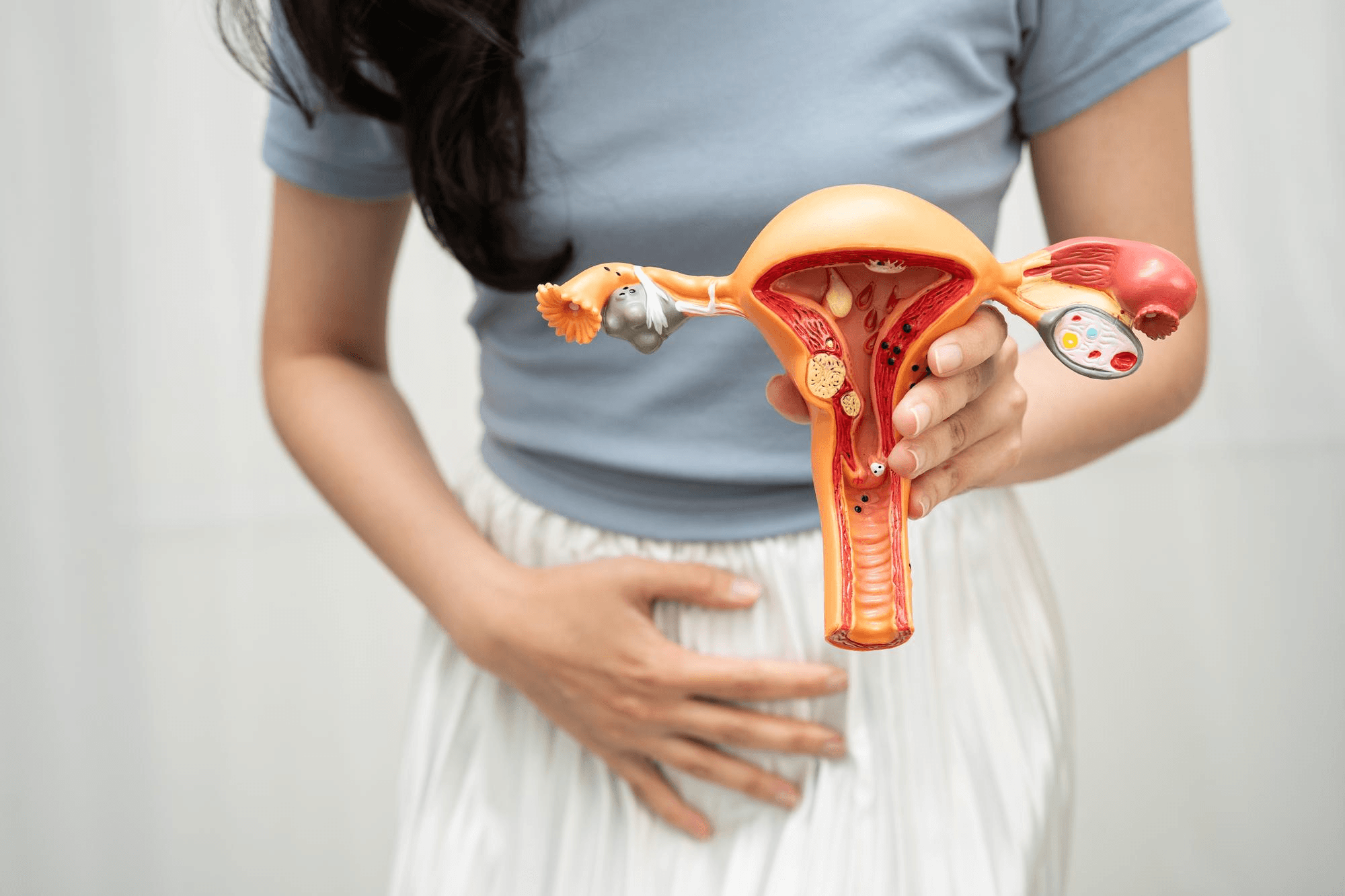
Female showing a model of a uterus and ovaries in anatomical form as she discusses the development of an ovarian cyst and reproductive health.
Most paraovarian cysts produce no symptoms at all. But if yours is causing any of the following, it is time to see your gynecologist:
- Persistent pelvic or lower abdominal pain - dull, aching, or a feeling of fullness
- Pain that worsens during or after your period
- Frequent or painful urination - from pressure on the bladder
- Constipation or bloating - from pressure on the bowel
- A heavy, dragging sensation in the lower abdomen
- Sudden, severe abdominal pain with nausea or vomiting - this needs urgent evaluation as it may indicate torsion.
How Is A Paraovarian Cyst Diagnosed?
Paraovarian cysts are usually diagnosed through pelvic examinations and imaging tests that help determine the cyst’s size, location, and potential impact on surrounding reproductive organs.
1. Pelvic Ultrasound
This is almost always the first investigation. A transvaginal ultrasound (TVS) gives the clearest picture of the cyst's size, location, and characteristics. The critical finding that distinguishes a paraovarian cyst from an ovarian cyst is seeing the ovary separately, confirming the cyst is adjacent to the ovary, not arising from it.
2. MRI
When the ultrasound picture is not conclusive, the ovary cannot be seen clearly as separate from the cyst, or the cyst has unusual features, an MRI provides a more detailed image without any radiation exposure.
3. Blood Tests (CA-125 And Other Tumour Markers)
These are not used to diagnose paraovarian cysts routinely, but they may be ordered if the cyst has suspicious features, if there is a family history of ovarian cancer, or if the cyst is large. It is important to note that elevated CA-125 can have many causes beyond cancer, and a single elevated result should never be the sole basis for concern.
4. Diagnostic Laparoscopy
In cases where imaging remains inconclusive or when surgical treatment is being considered anyway, a diagnostic laparoscopy confirms the diagnosis with certainty. The surgeon views the cyst directly through a camera.
Treatment Options: When Is Surgery Needed?
Treatment for a paraovarian cyst depends on its size, symptoms, and complications, with surgery usually recommended only in specific or severe cases.
1. Watch And Wait
For small paraovarian cysts (typically under 5 cm) that appear simple on ultrasound and cause no symptoms, the standard approach is watchful monitoring. Your gynecologist will schedule follow-up ultrasounds, usually every 6 to 12 months, to check that the cyst is stable and not growing. No medication makes paraovarian cysts shrink; unlike some ovarian cysts, they do not respond to hormonal treatments. The choice is between monitoring and surgical removal.
2. Laparoscopic Cystectomy
When a cyst is large, growing, causing symptoms, has suspicious features on imaging, or has caused complications like torsion, surgical removal is recommended. The preferred surgical approach is laparoscopic cystectomy, keyhole surgery using small incisions, a camera, and fine instruments to remove the cyst while leaving the ovary and fallopian tube intact.
This is minimally invasive, typically done as a day procedure or with one night in the hospital, and has an excellent recovery profile. Most women are back to normal activity within one to two weeks. In the Indian clinical study cited earlier, 84% of paraovarian cysts were managed by laparoscopy, confirming it as the go-to approach in surgical cases.
3. Emergency Surgery For Torsion Or Rupture
If a cyst has twisted or ruptured, emergency laparoscopic surgery is performed to untwist the tissue, restore blood supply, and remove the cyst. In these cases, speed matters; delay increases the risk of permanent damage to the ovary.
Does A Paraovarian Cyst Affect Fertility?
For most women, a paraovarian cyst does not affect fertility. The cyst does not sit on the ovary, does not interfere with ovulation, and does not block the fallopian tube in most cases. If complications like torsion occur and are not addressed promptly, the resulting damage to the ovary or tube could theoretically affect fertility, which is one more reason why sudden, severe pelvic pain always warrants urgent evaluation rather than waiting to see if it passes.
Surgical removal of the cyst through laparoscopy, when done by an experienced surgeon, preserves the ovary and fallopian tube and does not negatively affect fertility in the vast majority of cases.
Getting The Right Evaluation In Noida And Greater Noida

A woman holds an anatomical model of the uterus and ovaries.
If you have been told you have a paraovarian cyst, whether it came up on a routine scan or alongside symptoms you have been ignoring, the right step is a proper evaluation with a gynecologist who can give you an honest picture of what it means for your specific situation.
Not every cyst needs surgery. Not every cyst can be left alone. The answer depends on the cyst's size, characteristics, and what you are experiencing. That conversation is one you should have with a specialist, not with a search engine.
Dr. Shachi Singh at Prakash Hospital, Sector 33, Noida, provides comprehensive gynecological evaluation and minimally invasive surgical care for women across Noida and Greater Noida. If you have a cyst that needs expert assessment, whether it was found incidentally or is causing discomfort, she will give you a clear, honest evaluation and a plan that makes sense.
To book a consultation with Dr. Shachi Singh, call: +91 97023 46853
Clinic Hours: Monday to Saturday, 9 AM – 6 PM | Sunday, 10 AM – 2 PM
Clinic Address: D-12A, 12B, Sector-33, G.B. Nagar, Noida, Uttar Pradesh 201301
Frequently Asked Questions
1. Is a paraovarian cyst the same as an ovarian cyst?
No. A paraovarian cyst forms near the ovary in the tissue of the broad ligament rather than on or inside the ovary itself. They have different origins, different hormonal behaviour, and slightly different management approaches, though they can look similar on ultrasound.
2. Can a paraovarian cyst go away on its own?
Small, simple paraovarian cysts sometimes resolve on their own. Your gynecologist will monitor the cyst over time with follow-up ultrasounds. Hormonal medication does not shrink paraovarian cysts the way it can with some types of ovarian cysts.
3. Is surgery always necessary?
No. Many paraovarian cysts are simply monitored over time. Surgery is recommended when the cyst is large, growing, causing symptoms, has suspicious features, or when a complication like torsion has occurred.
4. Can a paraovarian cyst cause pain during periods?
It can. Larger cysts can cause pelvic discomfort that may worsen around the time of your period due to general pelvic inflammation and pressure, even though the cyst itself is not hormonally driven.
5. Will removing a paraovarian cyst affect my ability to get pregnant?
In most cases, no. Laparoscopic cystectomy is designed to preserve the ovary and fallopian tube. If surgery is done carefully by an experienced laparoscopic surgeon, fertility is typically unaffected.
6. Should I be worried if my ultrasound found a small paraovarian cyst with no symptoms?
A small, simple, asymptomatic paraovarian cyst is generally not a cause for alarm. Follow your gynecologist's advice about monitoring intervals and report any new symptoms promptly. Routine follow-up is the appropriate response; panic is not.
This blog is written for educational and informational purposes only. It is not a substitute for professional medical advice. Please consult Dr. Shachi Singh or a qualified gynecologist for evaluation specific to your condition.