Ovarian Cancer Screening: Why It Is So Difficult and What High-Risk Women Should Do
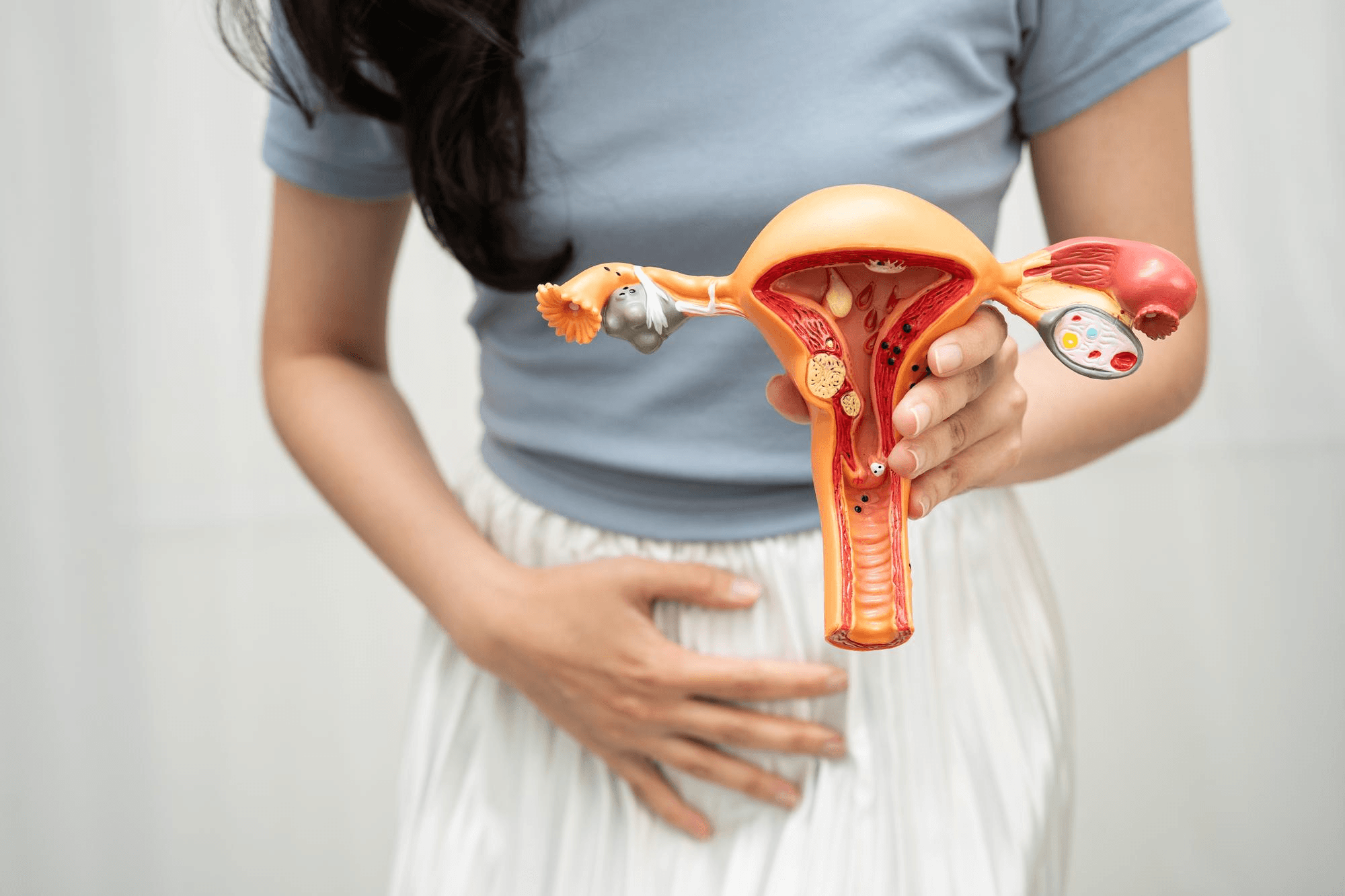
Female showing a model of a uterus and ovaries in anatomical form as she discusses the development of an ovarian cancer.
Ovarian cancer is one of the most feared gynaecological malignancies — not because it is particularly common, but because it is so frequently diagnosed at an advanced stage. While cervical cancer can be detected years before it becomes invasive through the Pap smear, ovarian cancer has no equivalent screening tool.
Understanding why ovarian cancer screening is so difficult — and what is actually recommended for women at elevated risk — is more useful than seeking tests that cannot deliver what they appear to promise.
Dr. Shachi Singh, consultant gynaecologist at Prakash Hospital, Sector 33, Noida, explains.
Why Ovarian Cancer Is Difficult to Screen For
Anatomical location: The ovaries are deep in the pelvis, not accessible to direct examination the way the cervix is. They cannot be viewed directly without imaging or laparoscopy.
Early disease is asymptomatic: Unlike cervical cancer, where pre-cancerous changes are visible on the cervix years before cancer develops, early-stage ovarian cancer produces no symptoms and no detectable surface changes.
No pre-malignant stage: The cascade of cervical cancer — normal cells → CIN 1 → CIN 2/3 → cancer, taking years — does not have a well-characterised equivalent in ovarian cancer. Most ovarian cancers arise from the fallopian tube epithelium (high-grade serous ovarian cancer, the most common subtype) and progress relatively quickly.
Available tests are not specific enough: The CA-125 blood test and ultrasound — the two most commonly used investigations — do not perform adequately as population screening tools because their specificity is insufficient. The majority of CA-125 elevations in premenopausal women are from benign causes (endometriosis, fibroids, PID, even menstruation). This means widespread CA-125 screening produces enormous numbers of false positives — women investigated with anxiety and sometimes surgery for benign conditions — without reliably detecting early cancer.
Large randomised controlled trials of ovarian cancer screening (including the UK Collaborative Trial of Ovarian Cancer Screening — UKCTOCS, enrolling over 202,000 women) have not found a significant mortality benefit from population screening with ultrasound and CA-125.
What CA-125 Is Useful For
While CA-125 is not a useful population screening tool, it has real clinical utility in specific contexts:
Monitoring known ovarian cancer: CA-125 is an excellent marker for tracking treatment response and detecting recurrence in women who have been diagnosed with ovarian cancer.
Pre-operative assessment of an adnexal mass: When a woman has an ovarian mass on ultrasound, CA-125 (combined with ultrasound characteristics) helps estimate the probability of malignancy and guides surgical planning. The RMI (Risk of Malignancy Index) and IOTA (International Ovarian Tumour Analysis) criteria combine these factors to risk-stratify ovarian masses.
HE4 (Human Epididymis Protein 4): A newer biomarker that, combined with CA-125 (ROMA score — Risk of Ovarian Malignancy Algorithm), improves the accuracy of distinguishing benign from malignant ovarian masses.
Who Is at High Risk of Ovarian Cancer
Most ovarian cancers (approximately 90%) are sporadic — occurring in women without a significant hereditary risk factor. However, approximately 10 to 15% are hereditary, predominantly from BRCA1 and BRCA2 gene mutations.
BRCA1 mutation: Lifetime risk of ovarian cancer approximately 40 to 50% (vs 1.4% in the general population).
BRCA2 mutation: Lifetime risk approximately 10 to 20%.
Lynch syndrome (hereditary non-polyposis colorectal cancer — HNPCC): Elevated risk of ovarian cancer and endometrial cancer.
Family history: Having a first-degree relative (mother, sister) with ovarian cancer increases risk approximately 3-fold.
What High-Risk Women Should Do
For women with BRCA1/BRCA2 mutations or strong family history, specialist surveillance and risk-reduction options are available:
Genetic counselling and testing: Women with significant family history of ovarian or breast cancer (multiple affected relatives, particularly first-degree; young age of onset) should be referred for genetic counselling to assess whether BRCA testing is appropriate.
Surveillance (for women who have not yet undergone risk-reducing surgery): Transvaginal ultrasound and CA-125 every 6 to 12 months from age 30 to 35. Note: this surveillance has not been proven to reduce mortality in BRCA carriers, but it is offered for reassurance and to detect the earliest possible changes while definitive risk-reduction surgery is considered or awaited.
Risk-reducing bilateral salpingo-oophorectomy (RRSO): Surgical removal of both fallopian tubes and ovaries significantly reduces ovarian cancer risk in BRCA1 and BRCA2 carriers — by approximately 80% for BRCA1 and 75% for BRCA2. Recommended typically after the age of 35 to 40 in BRCA1 carriers (earlier risk) and 40 to 45 in BRCA2 carriers, after completing childbearing. Induces surgical menopause — HRT is recommended until natural menopause age.
Oral contraceptive pill: Consistent OCP use reduces ovarian cancer risk by approximately 40 to 50% in the general population and provides meaningful risk reduction in BRCA carriers. This benefit accrues with longer duration of use.
Symptoms to Know and Report
In the absence of effective population screening, symptom awareness is the most practical tool for early detection:
- Persistent bloating (daily, not coming and going)
- Feeling full quickly after eating small amounts
- Persistent pelvic or abdominal pain
- Increased urinary urgency or frequency
These symptoms occurring on most days for 3 weeks or more should prompt prompt clinical evaluation — pelvic examination, CA-125, and transvaginal ultrasound. While most cases of these symptoms have benign causes, they are the constellation most associated with early ovarian cancer.
Gynaecological Care in Noida and Greater Noida
Dr. Shachi Singh at Prakash Hospital, Sector 33, Noida, assesses ovarian cancer risk, evaluates adnexal masses, and coordinates specialist referral for high-risk women across Noida and Greater Noida.
To book a consultation with Dr. Shachi Singh, call: +91 97023 46853
Clinic Hours: Monday to Saturday, 9 AM – 6 PM | Sunday, 10 AM – 2 PM
This blog is for informational purposes only. Please consult Dr. Shachi Singh or a qualified gynaecologist for risk assessment and management specific to your family history and clinical situation.